Package Information


Documentation
n8n-nodes-minimax-unified


An n8n community node for MiniMax AI. It exposes MiniMax chat-completion endpoints as regular n8n nodes and as a Language Model node usable inside AI Agent / Chain workflows.
This package was created because existing MiniMax community nodes do not cover both regions and the newer models at the same time — see Why another package? below.
Table of contents
- Features
- Install
- Credentials
- Nodes
- Screenshots
- Why another package?
- Troubleshooting
- Build from source
- License
Features
- Dual region — pick
International (api.minimax.io)orChina (api.minimaxi.com), matching where your API key was issued. - Standard and Coding Plan — Standard uses the OpenAI-compatible endpoint (
/v1/text/chatcompletion_v2); Coding Plan uses the Anthropic-compatible endpoint (/anthropic/v1/messages). - Custom Base URL — point at a proxy or private deployment.
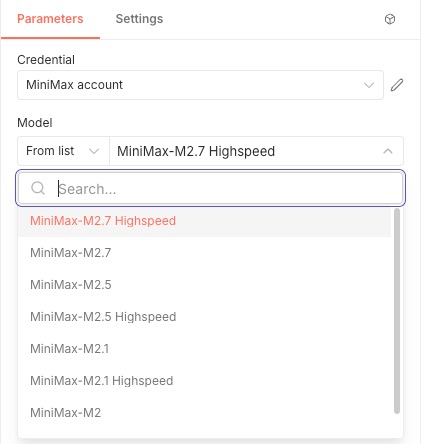
- Model picker with free-form input — choose a known model from the list, or type any model ID your account supports (so new models work without waiting for a package update).
- Two nodes — a regular
MiniMaxnode and aMiniMax Chat Modelnode for AI Agent / Chain. - Bearer prefix handled for you — paste the raw key;
Beareris added automatically and stripped if pasted by mistake.
Bundled model list: MiniMax-M3, MiniMax-M2.7, MiniMax-M2.7-highspeed, MiniMax-M2.5, MiniMax-M2.5-highspeed, MiniMax-M2.1, MiniMax-M2.1-highspeed, MiniMax-M2, M2-her. Any model ID outside this list can still be used via the free-form input.
Install
Option 1 — n8n Community Nodes (recommended)
In n8n: Settings → Community Nodes → Install and enter:
n8n-nodes-minimax-unified
Option 2 — Local custom extension
git clone https://github.com/xi0yu/n8n-nodes-minimax-unified.git
cd n8n-nodes-minimax-unified
npm install
npm run build
mkdir -p ~/.n8n/custom
ln -s "$(pwd)" ~/.n8n/custom/n8n-nodes-minimax-unified
# restart n8n
Credentials
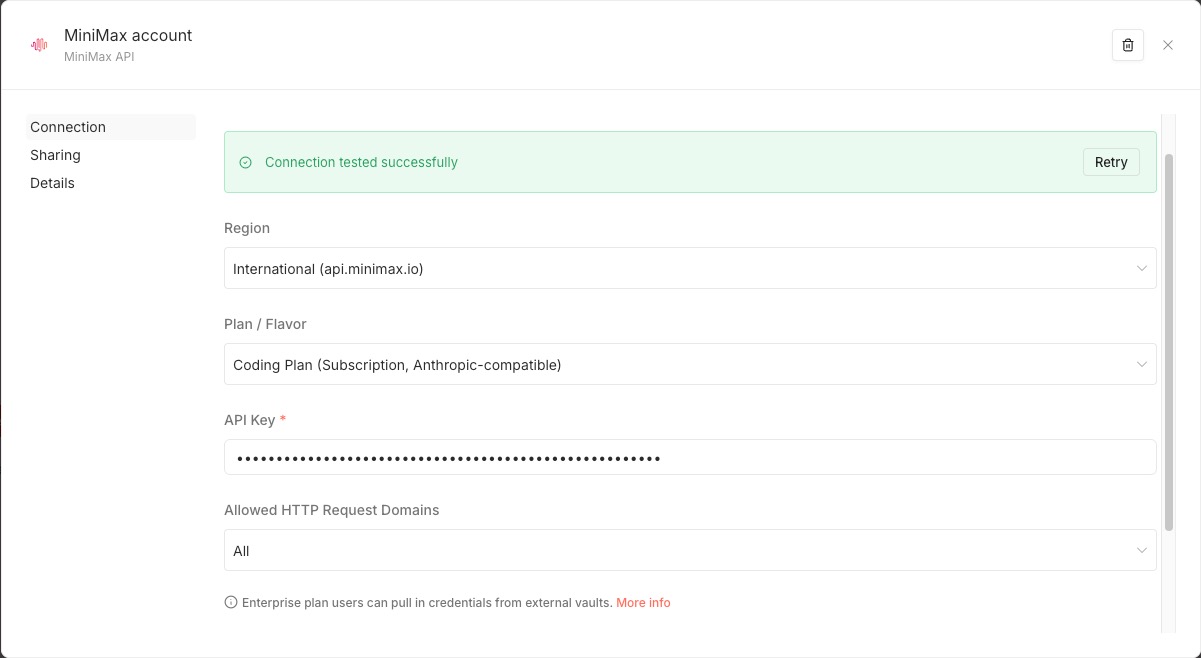
Create a credential of type MiniMax API:
| Field | Notes |
|---|---|
| Region | International (api.minimax.io), China (api.minimaxi.com), or Custom Base URL |
| Custom Base URL | Only shown when Region = Custom. Base URL with no trailing slash. |
| Plan / Flavor | Standard (Pay-as-you-go, OpenAI-compatible) or Coding Plan (Subscription, Anthropic-compatible) |
| API Key | Paste the raw key. Do not include Bearer — the node adds it automatically. |
| Group ID | Optional. Appended as a GroupId query-string parameter on Standard endpoints. Coding Plan does not use it. |
Standard keys and Coding Plan keys are issued separately in the MiniMax console and are not interchangeable. Make sure the Plan field matches the key you generated.
Nodes
This package ships two nodes:
MiniMax
A regular node for chat completion. Use it when you want full control over the request (messages array, temperature, etc.) in a normal workflow.
- Resource:
Chat - Operation:
Complete→POST /v1/text/chatcompletion_v2(Standard) orPOST /anthropic/v1/messages(Coding Plan) - Model: resource locator with searchable list + free-form input
MiniMax Chat Model
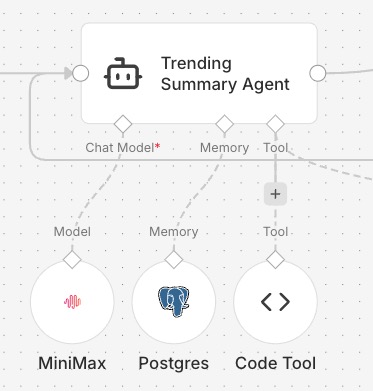
A Language Model sub-node intended for use with AI Agent and Chain nodes. Internally it uses:
@langchain/openaiwhen the credential's Plan isStandard@langchain/anthropicwhen the credential's Plan isCoding Plan
You plug it into an AI Agent's Language Model input the same way you would plug in an OpenAI or Anthropic chat model.
Screenshots
Why another package?
A few MiniMax community nodes already exist. Each is useful; this package was built to fill gaps observed at the time of writing:
n8n-nodes-minimax-chathardcodes the international endpoint (api.minimax.io) in its credential test and request routing. Keys issued on the China console (platform.minimaxi.com) fail the credential test with401 Authorization failed.n8n-nodes-minimaxsupports both regions and Coding Plan correctly; its bundled model list stops atMiniMax-M2.5and newer IDs such asMiniMax-M2.7are not selectable from the built-in dropdown.
The main additions in this package are:
- Up-to-date bundled model list, including
MiniMax-M3(1M context) andMiniMax-M2.7with its highspeed variant. - Free-form model input alongside the dropdown, so any future model ID works without waiting for a package update.
Those are the only meaningful differences to be aware of. If the packages above add equivalent support, the credential shape here is deliberately similar so you can switch with minimal rework.
Troubleshooting
401 Authorization failed on credential test.
Check the Region field. An api.minimax.io key will not authenticate against api.minimaxi.com and vice versa. Also double-check the Plan field: a Coding Plan key will fail against the Standard endpoint.
Unknown model / 400 error.
If you typed a model ID in the free-form input, verify it is enabled on your MiniMax account. The dropdown only lists models this package knows about; the API enforces what your account can actually use.
Coding Plan returns content but AI Agent output looks empty.
AI Agent and Chain nodes expect OpenAI-style output shapes. When using Coding Plan, the node uses @langchain/anthropic internally to adapt Anthropic responses, so most agent flows work. If you see empty output, please open an issue with the workflow JSON attached.
The package is not showing up in npm search yet.
The npm search index lags behind publication by several weeks for new packages. npm install n8n-nodes-minimax-unified works regardless, as does the n8n Community Nodes installer.
Build from source
npm install
npm run build    # compile TS + copy icons into ./dist
npm run verify   # sanity-load the compiled nodes and credentials