Package Information
Available Nodes
Documentation generating…

Documentation

nybrix Anonymisation



Anonymise and deanonymise text in n8n workflows using the nybrix Anonymisation Pipeline — AI-powered PII detection with full reversibility.
The nybrix Anonymisation Pipeline detects personally identifiable information (PII) in free-text documents — names, addresses, financial identifiers, and more — and replaces each entity with a consistent synthetic substitute, making documents safe to share, store, or pass to LLMs without violating data protection requirements. The same node can reverse the process, restoring original values on demand via an encrypted server-side mapping table. All data is processed exclusively within the EU.
n8n is a fair-code licensed workflow automation platform.
A note on terminology: "Anonymisation" is used as the common shorthand throughout this node and its documentation. Technically the process is pseudonymisation under Art. 4(5) GDPR — the mapping between original and synthetic values is stored server-side and can be reversed. Processed data therefore remains personal data. See Important Limitations for the full legal context.
Installation · Getting Started · Operations · Credentials · Supported PII Categories · Detection Accuracy · Supported Formats · Usage · Options Reference · Error Handling · Data Privacy & Security · Important Limitations · Compatibility · Resources · Version History
Installation
From the n8n UI (recommended)
- Open your n8n instance
- Go to Settings → Community Nodes → Install
- Enter
n8n-nodes-nybrix-anonymisation - Click Install
This works for n8n Cloud and self-hosted instances running n8n 1.0.0 or later.
Manual (self-hosted)
npm install n8n-nodes-nybrix-anonymisation
Then restart your n8n instance.
Development
See docs/setup.md for the local development workflow (npm run dev).
Getting Started
You need a Nikan AI account and an active API key before the node can process any requests.
1. Register on the Nikan AI Platform
Create an account at console.nikan.ai.
2. Set Up Your Organisation
After registering, create a Company profile and add a User account linked to it.
3. Get Credits
New accounts include a starter token balance. Additional tokens can be purchased at any time through the Key Management Portal. The n8n node itself is free — you only pay for the tokens consumed by the API when processing documents.
4. Activate the Product
In the Key Management Portal, activate the Anonymisation Pipeline product for your organisation.
5. Generate an API Key
Create an API key in the portal. Copy it — you will enter it as a credential in n8n.
Important: Your API key is used to derive the encryption key for your mapping table. If you rotate your API key, previously stored mappings become undecryptable and deanonymisation of older documents will not be possible. Keep your key safe and plan rotations carefully.
6. Add the Node to Your Workflow
In n8n, search for nybrix Anonymisation in the nodes panel, drag it into your workflow, and configure the credential (see Credentials below).
Operations
| Operation | Description | Notes |
|---|---|---|
| Anonymise | Detects PII in the input text and replaces each entity with a consistent synthetic substitute. Returns a pseudonymised document and a requestId for later deanonymisation. |
Uses an async queue — the node polls until the result is ready. |
| Deanonymise | Restores the original values in a previously pseudonymised document using the encrypted server-side mapping table. | Deterministic DB lookup — no AI involved. Requires the requestId from the original anonymise call (pass it as part of the text or workflow context). |
Output JSON shape
{
  "requestId": "01a381fb-2c13-450e-b82d-9e55ef59ffb2",
  "result": "Dear Mr. Erik Müller, thank you for your enquiry dated 12 June 2026. ...",
  "operation": "anonymise"
}
Store the requestId in your workflow if you need to deanonymise the same text later — it links the synthetic substitutes back to the original values on the server.
Example
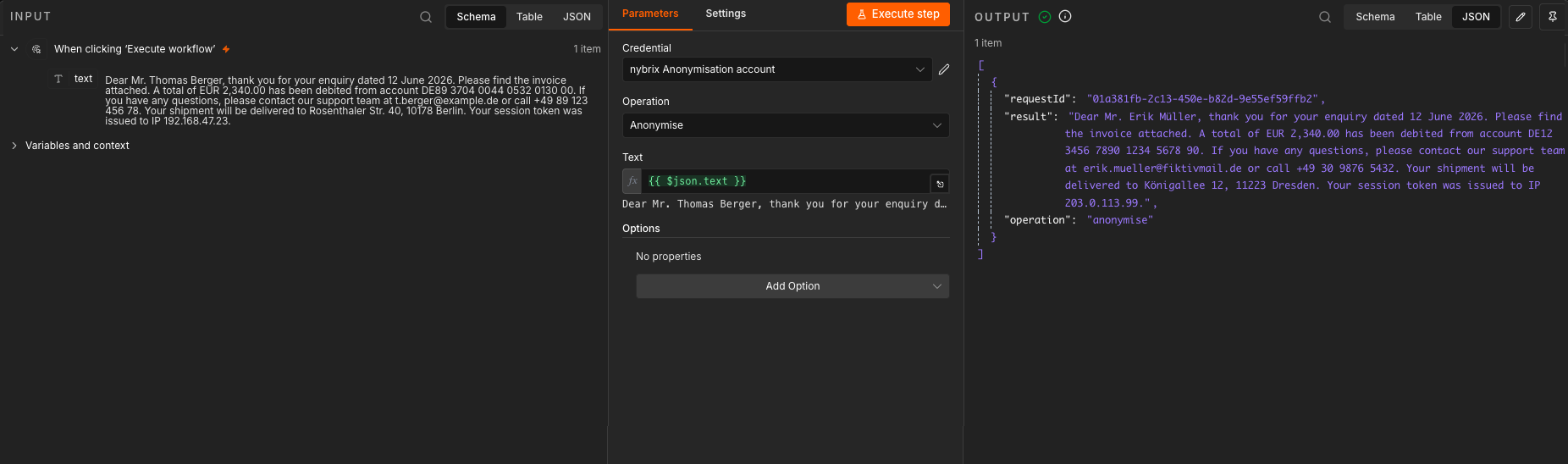
The pipeline replaces each PII entity with a realistic synthetic substitute — the document remains fluent and natural, not filled with placeholder tokens.
Input:
Dear Mr. Thomas Berger, thank you for your enquiry dated 12 June 2026.
Please find the invoice attached. A total of EUR 2,340.00 has been debited
from account DE89 3704 0044 0532 0130 00. If you have any questions, please
contact our support team at t.berger@example.de or call +49 89 123 456 78.
Your shipment will be delivered to Rosenthaler Str. 40, 10178 Berlin.
Your session token was issued to IP 192.168.47.23.
Anonymised result:
Dear Mr. Erik Müller, thank you for your enquiry dated 12 June 2026.
Please find the invoice attached. A total of EUR 2,340.00 has been debited
from account DE12 3456 7890 1234 5678 90. If you have any questions, please
contact our support team at erik.mueller@fiktivmail.de or call +49 30 9876 5432.
Your shipment will be delivered to Königsallee 12, 11223 Dresden.
Your session token was issued to IP 203.0.113.99.
Credentials
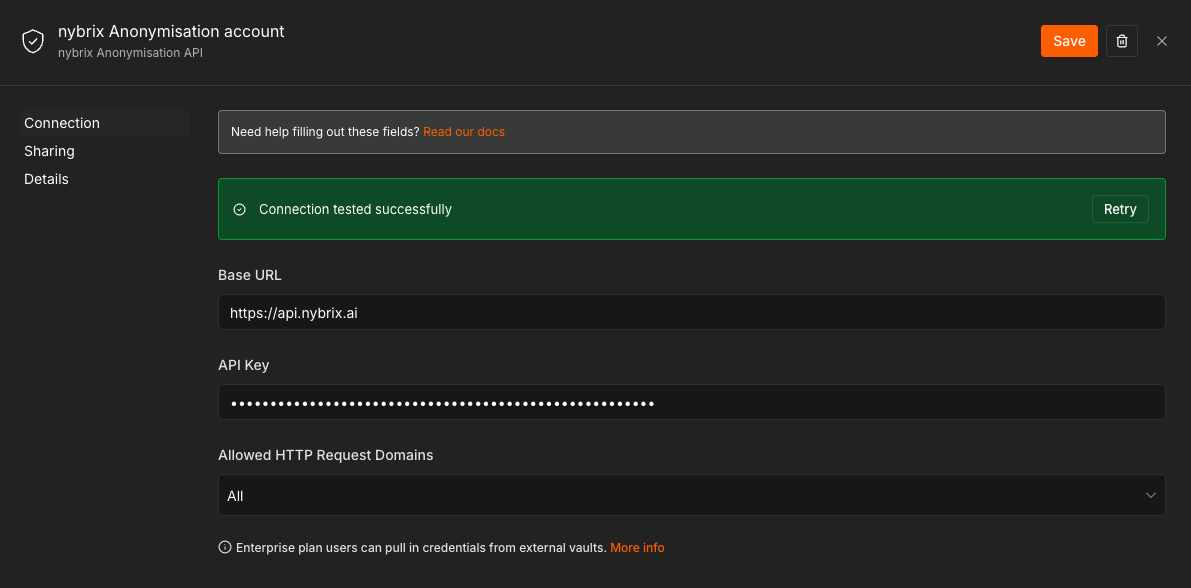
The node authenticates with the nybrix Anonymisation API using the nybrix Anonymisation API credential type.
Required fields
| Field | Description |
|---|---|
| Base URL | The URL of the nybrix Anonymisation API server (pre-filled: https://api.nybrix.ai) |
| API Key | Your X-API-Key value from the Nikan AI Key Management Portal |
To configure
- In n8n, go to Credentials → New credential
- Search for nybrix Anonymisation API
- Enter the Base URL of your deployment
- Paste your API Key
- Click Test — n8n pings the server to verify connectivity
- Click Save
The Base URL is pre-filled with https://api.nybrix.ai — no change needed for production use. For local development, replace it with your local server URL (e.g. http://localhost:8000).
Supported PII Categories
The AI model detects and pseudonymises personal data in free-text documents. Detection reliability varies by entity type. The table below reflects measured performance across an independent evaluation of 475 entities spanning 60 documents and 9 document types (see docs/evaluation-report.md for the full results).
Core entities — reliably detected (≥ 97% recall)
| Category | Entity types |
|---|---|
| Person identity | Full names, dates of birth, national ID numbers, passport numbers, SSNs / tax IDs |
| Contact | Postal addresses (street, city, state, ZIP/postcode), email addresses, phone numbers |
| Financial | IBAN, bank account numbers, credit card numbers |
| Digital identifiers | IP addresses, user IDs, cookie IDs |
Contextual entities — partially detected (variable recall)
| Entity type | Typical recall | Notes |
|---|---|---|
| Country names | ~73% | May be missed when used as adjectives or in formal titles |
| Standalone dates | ~80% | Dates appearing in isolation without a person-linking context |
| Ages | ~80% | Numeric ages (e.g. "45 years old") occasionally missed |
Not currently detected
The following entity types are not reliably pseudonymised at this time:
- Company / organisation names — rarely detected (< 7% recall in evaluation)
- Job titles and role names — not detected (0% recall in evaluation)
If your documents contain company names or job titles that must be protected, apply a pre-processing step or manual review before passing the text to this node.
Within a single API call, the same PII entity always maps to the same pseudonym. Across separate calls, consistency is maintained via the server-side mapping table as long as the same API key is used.
Detection Accuracy
An independent evaluation run on 2026-06-30 tested the pipeline across 60 documents and 7 real-world scenario configurations (financial crime, healthcare, customer support, HR, rental, clinical intake, and international/passport documents). 475 labeled PII entities were evaluated.
| Metric | Result |
|---|---|
| Critical-PII recall | 99.6% — names, emails, phones, addresses, national IDs, SSNs, passports, dates of birth, credit cards, IBANs |
| Overall recall | 93.3% — all entity types including low-salience contextual entities |
| Round-trip deanonymisation | 97.3% — pseudonymised documents successfully restored to original values |
Performance by scenario:
| Scenario | Overall Recall | Round-trip |
|---|---|---|
| Financial Crime & Legal | 100.0% | 100.0% |
| Customer Support | 100.0% | 96.7% |
| Rental & Housing | 100.0% | 100.0% |
| Clinical Patient Intake | 99.0% | 100.0% |
| Healthcare & Insurance | 98.1% | 99.4% |
| European & International | 96.3% | 86.8% |
| Career & Employment | 87.6% ¹ | 99.5% |
¹ Lower overall recall in this scenario is driven entirely by company names and job titles (0–7% recall); all high-criticality PII was detected at 100%.
A note on over-anonymisation: The pipeline errs on the side of caution. Some domain-specific phrases that are not PII (e.g. procedural terms like "account freeze" or "referral letter") may also be replaced with synthetic substitutes. The document remains grammatically coherent and the structure is preserved — the substituted phrases are simply fictional equivalents rather than the original text. For downstream processing, treat the anonymised output as authoritative and deanonymise only when you need to recover original values.
For the full per-document and per-entity breakdown, see docs/evaluation-report.md.
Supported Formats
| Format | Input | Output |
|---|---|---|
| Plain text (UTF-8) | ✓ | ✓ |
| Base64-encoded text | ✓ | ✓ |
| JSON (structured fields) | ✓ | ✓ |
| PDF / DOCX (native binary) | — | — |
Working with PDF and Office documents: The node processes text input. To anonymise a PDF or Word document, add a text-extraction step before this node in your workflow (e.g., an Extract from PDF community node), pass the extracted text to the nybrix Anonymisation node, then optionally repackage the result.
Usage
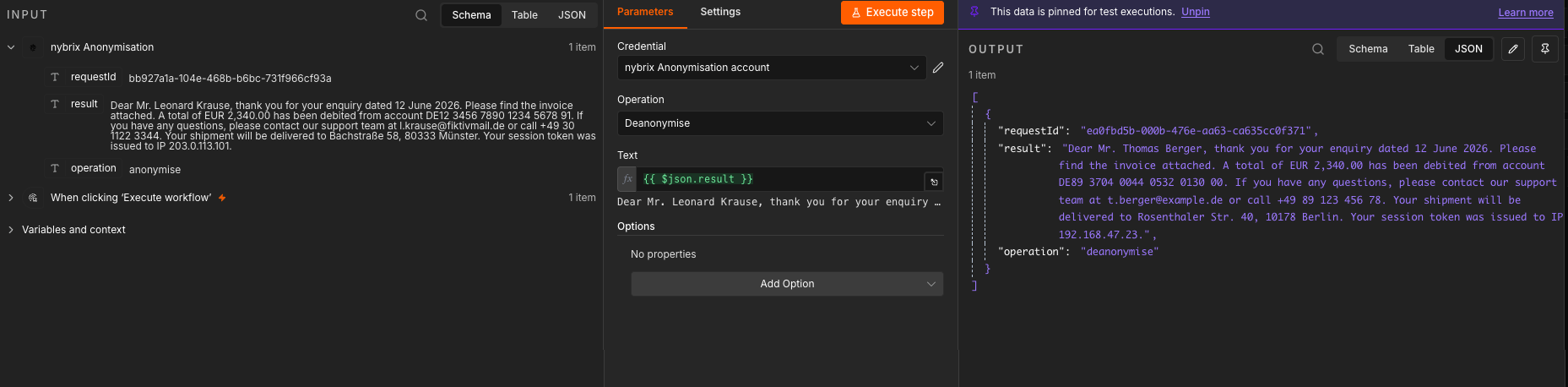
Basic anonymise → deanonymise workflow
- Add a Manual Trigger node
- Add a nybrix Anonymisation node — set Operation to
Anonymiseand Text to your input (or{{ $json.text }}from an upstream node) - Add a second nybrix Anonymisation node — set Operation to
Deanonymiseand Text to{{ $json.result }} - Execute — the second node's
resultwill match the original input exactly
Using the node as an AI Agent tool
The node has usableAsTool: true, which means it can be attached to an AI Agent node in n8n as a callable tool. The agent can invoke anonymisation on any text before passing it to an LLM, ensuring sensitive data never reaches external model providers. After the LLM call, the agent can deanonymise the response to restore original values — a complete privacy-preserving LLM pipeline.
Language support and accuracy
- English is the primary language with the highest detection accuracy
- German is supported in beta
- Other languages are experimental — detection quality may vary
- Detection quality may also be lower on very short texts, tabular data, or highly structured content such as source code
Options Reference
Open the Options section in the node to configure polling behaviour:
| Option | Default | Description |
|---|---|---|
| Max Retries | 60 |
Maximum number of status polls before the node times out |
| Polling Interval (Ms) | 1000 |
Milliseconds to wait between status polls |
Timeout = maxRetries × pollingInterval ÷ 1000 seconds. The default is 60 × 1,000 ms = 60 seconds.
For long documents or high server load, increase Max Retries and/or Polling Interval.
Error Handling
Continue on Fail
Enable Continue on Fail in the node settings (the gear icon) to prevent a single failed item from stopping the entire workflow. Failed items will include an error field instead of a result:
{ "error": "Authentication failed. Check your API key." }
Error conditions
| Message | Cause | Resolution |
|---|---|---|
Authentication failed. Check your API key. |
Invalid or missing API key | Verify your credential in n8n |
API key quota exceeded. |
Token balance exhausted | Recharge credits at console.nikan.ai or contact support@nikan.ai |
Request ID not found on server. |
Job expired before result was retrieved | Reduce polling interval or retry the full operation |
Transformation timed out after N attempts |
Server took longer than the configured timeout | Increase Max Retries or Polling Interval in Options |
Data Privacy & Security
| Parameter | Details |
|---|---|
| GDPR role of provider | Data Processor (Art. 28 GDPR) — customers are the data controllers |
| Processing location | EU only — Scaleway, Paris, France (ISO 27001-certified data centre) |
| Third-country transfers | None — all data stays in the EEA |
| Mapping table retention | Stored persistently (encrypted) to enable deanonymisation; deleted on request by the controller; backup propagation within 24 h |
| Input / output retention | Input and intermediate files: deleted immediately after processing. Output: deleted after 24 h |
| Sub-processors | Scaleway S.A.S. (hosting + database), Scaleway AI LLM Endpoint — full list in DPA Annex 3 |
| AI training with customer data | Explicitly prohibited — customer data is never used for model training |
| Transport encryption | TLS 1.3 for all connections |
| Encryption at rest | Fernet (AES-128-CBC + HMAC-SHA256), key derived from the organisation's API key |
A Data Processing Agreement (DPA) in accordance with Art. 28 GDPR must be concluded before productive use. All compliance documents are available at nikan.ai.
Important Limitations
Pseudonymisation, not anonymisation: The output is pseudonymised data under Art. 4(5) GDPR — not anonymised data under Recital 26. As long as the mapping table exists on the server, the processed data remains personal data. This product does not replace a Data Protection Impact Assessment (DPIA) by the data controller.
Probabilistic AI detection: There is no guarantee of complete or error-free detection of all PII entities. Measured recall for critical-PII categories (names, contact details, financial identifiers, national IDs) is 99.6% across an independent 60-document evaluation, but misses can and do occur — especially for lower-salience contextual entities. Company names and job titles are not reliably detected (< 7% and 0% recall respectively). Country names (
73%), standalone dates (80%), and ages (~80%) have reduced coverage. The pipeline also over-anonymises some non-PII phrases (domain-specific terminology may be pseudonymised along with true PII). For workflows involving special-category data (Art. 9 GDPR), a human reviewer is mandatory.Prohibited use cases: The product must not be used in high-risk AI contexts under Annex III of the EU AI Act — including employment, education, creditworthiness assessment, law enforcement, migration, justice, critical infrastructure, or biometrics. Medical or pharmaceutical research with patient data requires a separate written agreement.
One API key per controller: Multi-controller pooling under a single API key is not permitted. Each data controller must use their own API key and sign their own Data Processing Agreement.
API key rotation: Rotating your API key will make previously stored mapping entries undecryptable. Plan key rotations carefully and ensure all active pseudonymised documents are deanonymised beforehand.
Compatibility
- Minimum n8n version: 1.0.0
- Tested against: n8n 1.x
- Node.js: v22 or higher (for local development)
- n8n Nodes API version: 1
Compatible with n8n Cloud, self-hosted deployments, and the local development server (npm run dev).
Resources
- Nikan AI Key Management Portal
- Compliance Documents (DPA, Privacy Policy, EULA)
- Support: support@nikan.ai
- Security incidents: security@nikan.ai
- n8n Community Nodes documentation
Developer documentation (this repo):
- Setup guide
- API reference
- Architecture
- Internals deep-dive
- Testing guide
- Certification checklist
- Detection accuracy evaluation report
Version History
| Version | Date | Changes |
|---|---|---|
| 0.1.0 | 2026-06 | Initial release — Anonymise and Deanonymise operations over the nybrix Anonymisation API (JSON-RPC 2.0 / StreamableHttp transport) |